Sunday, March 25, 2012

#11: Scripted Scene Prep

In preparation for shooting my scripted scene assignment, I've compiled a production notebook that contains everything I'll need to stay organized on set and to ensure that the shoot goes smoothly. Inside are the script, shooting script, room layout and lighting plan, shot list, foley list, storyboard, and more.


The shooting script in my book has been annotated with shot numbers so that we can keep up with what's been covered already and what we need to shoot next.


For me, one of the greatest benefits of extensive pre-production planning is storyboarding. I always try to visit the location before the shoot to map out the lay of the room and spot available electrical outlets. I like to pace off the room to get a feel for its general dimensions, then map the whole thing out roughly in Photoshop or in 3D in Google Sketchup or FrameForge.


Once this is done, it's much easier to get a feel for the blocking and to quickly make decisions about lighting placement and such. Once you have a rendering of the room in front of you, problems with the space become much more apparent, saving you the time of running into those problems unexpectedly while you have crew standing around waiting to shoot.

After the room has been mapped, I usually get to work on a storyboard and sketch out a basic version of the types of shots I'd like to see. It is usually during this process that I feel I get the most inspiration as far as camera work is involved because I can see the composition of each shot as a tangible thing, juxtaposed together, in a way that lets me start editing the film in my head and working out the flow of the various sequences.


I also find that storyboarding helps me to start identifying a concrete visual style for the project, as the tone and emotion of the scenes tend to influence the way in which I draw the cells. I can't stress enough the importance of storyboarding in my particular creative process. For me, it's the stage where the idea becomes a visual reality for the first time.

Thursday, March 15, 2012

#10: Motivated Movement

This is a great example of effective motivated movement from Kill Bill, a film with some all around great cinematography.


This is one long extended take with the occasional hidden cut, achieved with careful choreography and extensive use of heavy equipment to control the movement of the camera. It does a good job of pulling the viewer in, giving them an all-seeing omnipotent view of the action taking place within the location for the scene.

The camera floats along, following Uma Thurmon's character as she infiltrates the House of Blue Leaves. It varies quickly from sweeping wide shots to tight close ups simply by reframing or moving in closer to a character. By the end of the impressive sequence, the viewer has been taken on a full 360 view of the space where a big showdown battle is about to occur, effectively selling the geography of the space and the reality of the fictional world contained within.

Thursday, March 1, 2012

#8 Scene Analysis - Shutter Island

In this opening scene from the film Shutter Island, we start out with a practically blank screen.

We discover that this is a field of fog as a boat emerges slowly.

From here, we cut into the interior of the boat to find our main character suffering from sea sickness.

We move into a closer shot where we see the face of Teddy for the first time, reflected in a mirror. The mirror is used a lot throughout the film and can represent the character's mental state as he searches within himself for meaning, and later in the film, searches for his very identity.

We move back to a wider shot as Teddy's introspection is interrupted by his sickness.


Teddy then turns and loks out of a porthole, and we see the expanse of water through a frame within a frame. We later find that Teddy feels trapped emotionally, and later he is trapped literally on an island, so there is significance in the use of the window and the water that surrounds them (and later the island).

Teddy throws water on himself, perhaps symbiotically trying to wash away his own sins.

Teddy looks again at himself in the mirror in this medium close up.

In the next shot, we see objects hanging in the foreground that appear to be shackles, drawing the audience into the story by piquing their curiosity as to why the chains and cuffs are even present on the boat.

Teddy emerges from another frame within a frame, adding weight to his emergence from the private space within the boat to the more public space without.


From a POV shot, we see another man on the boat through a fence that could, again, symbolize Teddy's sense of being trapped. The expanse of water beyond the edge of the boat helps to show how isolated the characters are.

From a medium wide shot, we see Teddy approach this other man. The sky is dark and overcast and the colors are muted, adding to the general atmosphere of the story.

We move to a medium 2 shot as Teddy gets closer to the other man and they become more personal with one another.

This shot is followed by a reverse medium wide shot where the audience can again see that the characters are surrounded by water on all sides.
As the two characters get acquainted, we move in a little closer. Notice that the new character is more resolute, standing at the front of the boat, while Teddy is less committed, hanging back slightly and never seeming comfortable within the frame. The other man looks ahead in the direction of travel, while Teddy looks all around and seems nervous.


We move in to an even closer two shot as the space becomes more personal while the two men share details about themselves.

The other man asks Teddy if he has a girlfriend or a wife, at which point we cut to a flashback. Teddy's wife is seen holding a tie and walking across the floor to him.

Here, her bare feet show that she is relaxed and comfortable in the environment as she approaches Teddy from behind.

In this two shot, the characters are comfortable and balanced and the lighting is very warm and soft, giving a sense of serenity and happiness.


We move in even closer to see the peaceful and happy expression on her face.

Suddenly, reality comes crashing back in like the waves of the sea and we cut to a dark shot of churning sea water and return to the previous location.

Here, Teddy is isolated and framed alone as he remembers his wife and seems to be contemplative, his eyes set just above the horizon line. Also, Teddy is looking in the direction opposite of the direction of travel of the boat, back into the past and his memories, and also in the direction where his wife was located in the previous flashback.

After Teddy gathers himself, we move back to a wider shot so as to include the other character.

The two men speak for a while and we move back and forth between two medium closeups.


We cut to the mysterious and foreboding titular island as it looms threateningly in the distance in this very wide shot. The lighting frames up the island nicely and its placement on the upper third makes it seem imposing.

When the captain of the boat arrives to speak with the men, he is set lower in the frame than the other two men because he is less important to the plot.

We move back to a more isolated Teddy as he seems to think about what may lie ahead on the island.

And finally, we cut to a POV from the boat as the landing dock nears, marking the end of the boat ride. The overwhelming mass of green foliage in the background makes the island seem exotic and dangerous, and the people on the dock are tiny and insignificant.

Monday, February 13, 2012

#7: Lighting

I tend to prefer lighting that is either very natural or highly stylized. I'm not terribly interested in the flat middle ground, I want it to be on one end of the spectrum or the other.

These nature shots by William Neil really work for me since they are both natural and stylized. The shadows cast by the mountains shot at just the right time of day highlight the golden hues along the edge of the ridge, much like a high key portrait of a person.


In this one, Neill uses very high contrast and reflections to achieve an otherworldly look in a completely natural setting.


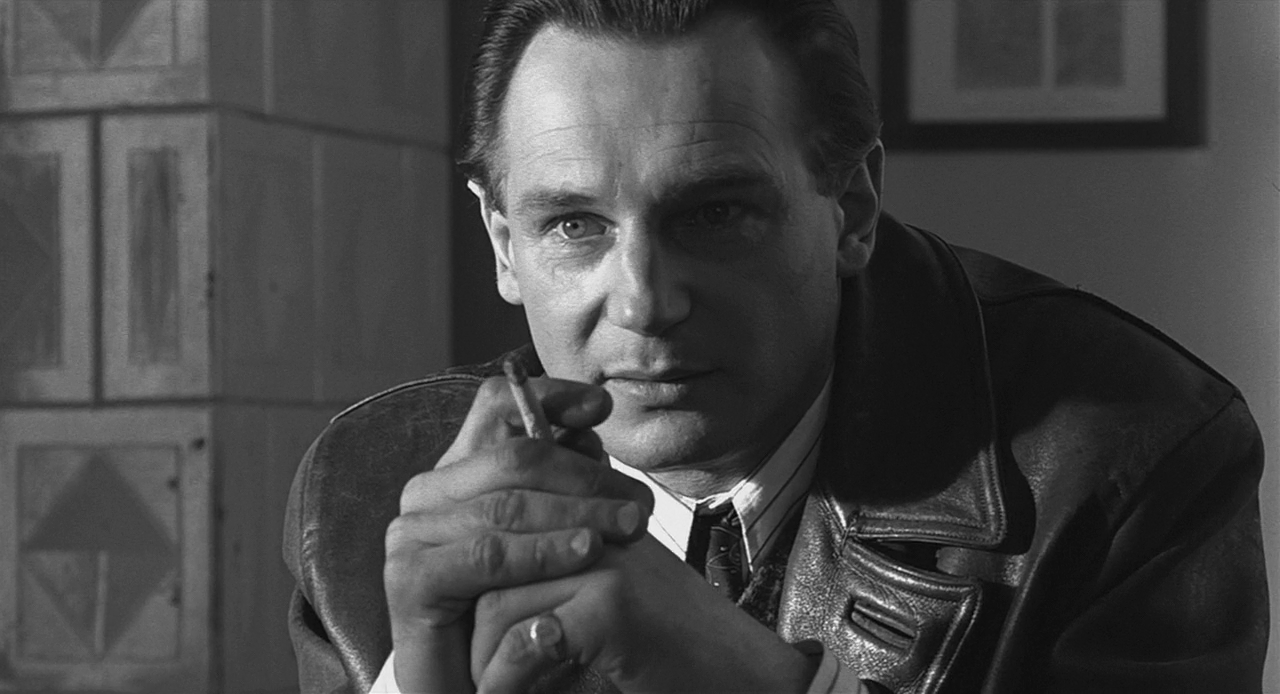
I've always liked the over-the-top dramatic lighting of the film noir style, and Spielberg seemed to be taking his cues from those aesthetics for much of Schindler's List. Here, he uses deep shadows to frame up the primary subjects so that there's no question as to what's important within the frame. The use of black and white film here adds to the ethos of the piece, and in my opinion gives weight to the seriousness of the subject matter.


David Fincher's films generally have very moody lighting. In these two shots from Se7en, again we see a low key resulting in strong shadows on one side of the subject's face. Fincher's movies seem to take place in a world where nothing else outside of the plot is happening, which I think helps keep the audience focused on the story. I believe lighting does a lot to help achieve that tone.


This screen grab from Pan's Labyrinth is beautiful, but it belies the ugliness that takes up much of the film. Here, the subject is looking up and toward the light, perhaps symbolic of her desire to escape from the circumstances of the plot.


Children of Men takes place in a dystopian future England where humanity is one generation away from total extinction, and the lighting and color in the film reflect that atmosphere. The exteriors look mostly naturalistic, but the sky is always dreary and wet and the greens of the countryside are lush like a jungle; like the proverbial wilderness waiting in the wings to encroach upon our cities once mankind is gone.


Finally, we have Bergman's Virgin Spring, a beautiful and powerfully moving film, albiet a very tragic and sad one. The characters are strongly lit and the shadows are often impenetrably deep, hinting at the darkness that lies in the hearts of man and at the heart of the story. In the lower screen cap, the lighting on the daughter is soft and white, making her seem innocent and cherubic. By contrast, her father has his face partially hidden in the shadows, suggesting that he knows of things that she does not that weigh heavily on his soul, and possibly foreshadowing the events of the film.


Saturday, February 4, 2012

#4: Reflection

So far this semester I've learned a good bit of practical, hands-on knowledge for working on an actual production set. I've picked up a number of terms that I hadn't heard before like "dead soldier" for an assembled stand sitting unused off set. The readings for this class have been very interesting and I'm really enjoying delving deeper into not only the technical aspects of the craft, but the psychology behind why certain visual concepts work in the way that that do. Most importantly, I've learned that if I'm the last one to get into the classroom, then I have to sit in one of the uncomfortable black plastic chairs.

I think the biggest challenge for has been simply maintaining focus when it comes to class and working on the set. While I'm very interested in the material, my brain just naturally moves in about 100 directions at once at any given time so it's very easy for me to get distracted. As a result, I often feel that I'm not quite on the same page as the rest of the group.

Also, I'm having some difficulty dealing with finding the time to work on shoot assignments since I have a very busy schedule that includes full-time classes, two different jobs on campus, and a good bit of freelance work outside of school. Just today, I was on campus from 8:00 A.M. until 9:00 P.M., and that's a fairly typical day for me.

My current schedule doesn't really leave any time for me to develop and work on my own projects, which is frustrating. I'm really looking forward to Spring Break, during which I will sleep late every day and hopefully manage to get some rest for the first time this semester.

While this may all read like a litany of complaints, I'm honestly quite happy to be a part of TCF and I feel lucky to be spending my time working within a field about which I am passionate and thoroughly enjoy.

Wednesday, February 1, 2012

#3: Goals

Currently, my primary goal as a filmmaker is to work in the industry and establish myself well enough that I can raise the capital to open a modestly-sized independent production house. This would give me the opportunity to work commercially on other people's projects while providing a support system and the equipment to develop my own films. Having the freedom to develop and produce my own projects has been a dream of mine for as long as I can remember, and opening a studio seems the most realistic and practical way to make that happen.

As far as this class is concerned, I think the main thing I'm hoping to accomplish is the learning of the ability to work well with others. I'm something of a hermit and I simply don't like being around other people for the most part. Film is, however, a hugely collaborative medium; so learning to play nice with others is an essential skill to be mastered.

Aside from that, I do feel fairly competent with the technical and artistic sides of filmmaking; but I believe that there's always more to learn so this class can only help. For every one thing I know how to do, I acknowledge that there are a thousand that I don't. Also, every person has their own individual take on filmmaking so I think there's a lot learn from taking the perspectives of others into consideration when developing one's own personal style. I hope to become a better filmmaker by broadening my horizons and learning how the guy to my left or the girl to my right might go about shooting a scene.